Mt. Fuji

Mt. Fuji
Absolutely Fantastic !!! Mt. Fuji, best viewed in winter, stands in blue sky without any clouds

Sunday, November 25, 2018

New Shot of Shibuya Intersection

Many people know what Shibuya Intersection is like.
Many tourists enjoy taking photos there, in the middle of the intersection or from the second floor of the Starbucks.

Shibuya Intersection (from the station side on the ground)


Shibuya Intersection (from the second floor of Starbucks)


The most amzing thing that I have ever had is that I happend to see a bride and groom taking a photo in the middle.

Some have had a chance to see MarioKarts passing through the intersection.


A shot that has never been taken before

On top of that, there has appeared a new spot where you can take a distintive shot of the intersection.
Take a look at the following  photo taken from right above it. 

So please come again to Shibuya if you'd like to have anything exciting much more than the regular scenes. You have to pay 5 dollars for the admission.


Thursday, November 22, 2018

Colored Leaves Lighted Up in Tokyo

Local people admire colored leaves lighted up at this time of the year.
There is an special event held in a Japanese garden called Rikugi-en, where hundreds of trees are lighted up in the evening.

a scene of a Japanese garden lighted up
Red leaves (right) show up in the darkness, in the contrast with an evergreen pine tree (left).
The conical framework of the pine tree is set in November as a preparation for winter, suportting its branches so as not to break due to snow weight.


an island in the pond
Their reflection on the water in the pond gives you different scenes that you don't have in the daytime.

The event lasts until Dec. 2.
 

Wednesday, November 21, 2018

Two statues in Tokyo Water Front

Maybe you don't know that Tokyo has the Statue of Liberty. 
It stands on the seashore in the innermost area of Tokyo Bay and just at the outlet of Sumida River, welcoming people who visit the water front.


The Statue of Liberty in Tokyo


It is in the middle of a reclaimed area called Odaiba, which is  a large resort town consisting of several shopping malls, exhibition halls, amusement buildings, a large Ferris wheel  and high-end condominiums, as well as office buildings in a trendy style.

Computer-operated trains, running on the elevated railroad,  connect them to downtown, giving passengers a good view of the water front.


a view from the water front
a view of Tokyo Bay

The Statue of GunDam
On the side opposite to the Statue of Liberty, there is the Statue of GunDam, a well-known hero character of animation movie originating in Japan. 

This is much larger than the statue of liberty. Moreover it moves the arms and the legs, appealing its mission to protect the earth.


The two statues represent the contrast between traditional and contemporary asptects of Tokyo.


Sunday, November 18, 2018

Do More for Less in Geisha show in Tokyo

Many tourists would like to see what geisha is like, but don't dare join the entertaiment.
Because it would be so expensive and punctillious in manners.  It also seems to be hard to make a reservation at a high-end Japanese restaurant.


Geisha Dance
Don't worry about any concerns on it. You'll have a good chance to see their dance performances and join some plays with them only if you come to Tokyo on Saturday evening with around 50 bucks in the pocket.

Two authentic geisha girls, accompanied by a Shamisen guitar player, show up just in front of you at a Japanese style of room downtown Tokyo.


Geisha in close-up
The show last for  90 minutes.
A cup of tea and some pieces of sweets are served, but no meal for dinner.

Nevertheless, you'll fully have a feeling of the traditional entertaiment that has been performed since the 17th century.


Saturday, November 17, 2018

Miyajima in Hiroshima

Miyajima is so unique among 80 thousand Shinto structures over the country.
It has a Torii gateway on the seashore, and the gateway soaks in the water when the tide comes in. 
In those days the nobility took a boat,  passed through it and stepped on the floor of the sanctuary.


a view of The Grand Torii Gateway from the sea
Now, you'll take a boat on the opposite side of the strait. The boat takes a detour so as to give you a view of the red gateway from the sea.  Unfortunately it arrives at a small port near the shrine without passing through the gate.

The Grand Torii Gateway on the ebb


The shrine, called Itsukushima Shrine, was restored by a local lord, who were in the first generation Samurai class in the 12th century. He indroduced aristocratic elegance into the structure: there is a main large hall in the middle, and on either side is a smaller sacred house connected to the main one with corridors. This is known as a form of crane with open wings.

Sea Road to the shrine
a drum shape of bridge

a side view of the shrine
You'll have a feeling of aristorats' tastefulness in the 12th century.


Friday, November 16, 2018

Please Keep Hiroshma in Your Mind

I'd like to recommend you to visit Hiroshima. You would understand something important for people in the world even if you are here to enjoy nature, culture and treasure of Japan. 


The Cenotaph of A-bomb Victims
More than seventy years have passed since then.
The survivors, who knows what tragegy happened, are  getting too old to keep talking about the reality. The number of them is also getting smaller and smaller.

People have to continue considering and speaking the consequence that was caused by the fact that the overwhelmingly-powerful bomb actually exploded 600 metes over the city.


The Cenotaph Inscription in Engish version

A boy, who joined my tour, asked me why it did not explode on the ground so as many explosive bombs do.

I answered that it had enormous amount of energy, such as heat and radioactive rays, so that it was more effective in damaging many soldiers and others under the focus of explosion. I added that it was supposed to have been designd in a different way.
The A-bomb Dome, a ruined building on the hypocenter


Wednesday, November 14, 2018

A Stunning View of Tokyo Tower

Many people have a beautiful view of Tokyo Tower wherever they are in Tokyo.
This, however, must be the most stunning one among its beautiful shots.


Tokyo Tower

Some people know the spot where the picture was taken.

It is in the private garden of a high-end traditional restaurant near the tower.

Maybe you haven't seen such an astonishingly- overwhelming scene of it.

It looks like it shows an aloof attidude after giving the role to the new one, Tokyo Sky Tree, which is two times higher than it.


Sunday, November 11, 2018

Mysterious Noh Performances

Noh is a traditional form of masked drama that has been performed since the 14th century.
Contemporary drama tends to focus on realism, but Noh is different and is atracting
in a completely different way.
 
Noh Stage (center) and Walkway (left)
Most Noh performances are presented indoors, but the stages all retain pillars and a roof that reflect the original covered outdoor stages where plays were performed.

Every indoor Noh stage also has a bridge-like walkway with railings, which is used as the metaphorical pathway between this world and the other world.

In some plays, the protagonist is a ghost, who appears on the stage through the pathway.
He expresses his unresolved feelings to his former foe.


Noh Actor
Many plays have just two characters. Musical accompaniment is provided only by a flautist, several drummers and a chorus.


Mask of Ghost
Noh actors move in a very distinctive way; wearing white socks, they use short sliding steps.

Noh acting is all about achieving maximum effect with a mask and minimal stylized movement.


Unchanged for centuries, Noh continues to give us a glimpse of the medieval sense of values and beauty as well as Buddhist overtones.


Tuna Auction at Toyosu Wholesale Markets

The wholesale part of Tsukiji Fish Markets moved to Toyosu on the 11th of October.
The 13th, Saturday, was the first day that visitors were allowed to look around inside the new buildings.

On the 15th, the first Monday since it opened, I visited there to see what the new markets were like.


Auction Area in Toyosu (in the middle)
Leaving home in the vicinity of Tokyo at 5:20 am, I arrived at the building at 6:30 am.
It is so good to be able to enter the area for tuna auction at 6:30 a.m. whereas visitors had to come to the gate of Tsuskiji Markets at around 2:30 a.m. to get entry tickets for the auction area.

The auction floor is on the first one, but we are led to the second one where we can look down the auction area through the glass windows.

There are number of frozen tuna on the floor. Smaller ones are in the middle and larger ones on the right side. Some viehcles carry several pieces of tuna.

Our room is silent. I cannot hear voices of wholesalers, which does not give us the feeling of being at a live auction. Hence it was less exciting than the experience in the former site in Tsukiji.


Auction Area in Toyosu (on the right side)

Viehcles carrying tuna


Fantastic World of Digital Art Museum in Tokyo

Digital Art Museum, which opened in March, 2018, is completely different from other museums.  

Flower Corridor
Stepping in through the black curtain, you are standing on a dark corridor.  You have to walk slowly, take about  20 steps forward, turn at the corner and then find yourself in front of the walls filled with colorful flowers, numerous petals of which are flying on the wall. Some of them are scattering at random while others are composing new flowers. Yes, the scenes are really fantastic, which does not exist on the earth.


There are several rooms in the museum. No route sign, however, can be seen. You are supposed to find your way to reach each of the rooms on your own.
After enjoying some displays on the first floor, you'll walk up several flights of stairs to the second floor, called Forest of Athletes.

This floor is a field of animals. Whales are swimming on the boundary wall.  Lizards are crawling  on the floor. Even flowers are growing quickly here and there.
 
Digital Aquarium
At the far end of the floor is Digital Aquarium.

Pick up a sheet of white papar on the shelves at the entrance.  It has a drawing of creature in the sea, such as sharks, jelly fish and squids. 
Color it with crayon and hand it over to the staff.

My squid named Teru starts swimming in the blue sea on the wall. It is amazing that it moves as an actural squid do. It looks as if it were alive although a squid in those colors does not exit in the sea.

So do jelly fish and sharks.

You'll find yourself enjoying watching others' creatures moving up and down as well as yours.

Saturday, January 31, 2015

KAMAKURA, where you'll see Japan's backbones that Tokyo does not show


Getting on a rapid train at Tokyo Station, you’ll arrive at the city of Kamakura in an hour or so.


The local city, located about 100 kilometers south from Tokyo, was the seat of the Japan’s first samurai or warrior government in the 13th century while Tokyo became the seat of the military government in the 17th century, 400 years after the Kamakura government was established. Needless to say, the epoch-making age in the Japanese history exerted a strong influence on the Japanese mind. 


I’d like to recommend you to see three Buddhist temples there as well as a famous  Shintoism shrine. The temples include Hase-dera, Kotoku-in and Engaku-ji. I’d say that it’s important to visit them in the order where I showed above. 


The first temple, the Hase-dera temple, is well-known for a Kannon image which is said to be curved in the 8th century. The standing image is around 9 meters high and characterized by ten small heads about its main crown, signifying the Deity of Mercy’s attempt to seek out all those in need of help. People believe that the Kannon Deity saves them from various hardships in their life, and they have donated small images to live up to its mercy.  So you’ll be surprised to see a large number of images in the precinct.   


The second one, the Kotoku-in temple, is famous for the great statue of Buddha, casted in the mid 13th century.  The seated Buddha, named Amida-Nyorai, is in the symbolized posture when Buddha enlightened 2500 years ago. It stands outdoors on the ground and is so huge and overwhelming with its height of 13 meters.  That is the main and only image of the temple, and people believe that he leads them to the Western Paradise or the Pure Land where they could be reborn and live a happy life if only they now chant the nenbutsu --- I obey the Amida sutra in Buddhism. --- to receive his protection. The temple is included in the Jodo or Pure Land sect of Buddhism.


The third one, the Engaku-ji Zen-Buddhist temple, was built in the late 13th century. It is located in the north area of the city while the former two temples are in the southwest. You’ll see greater architectures made of unvarnished woods, arranged in a line on a valley’s upslope towards the top of a mountain, surrounded by several- hundred-year-old cider trees which soar in the sky. What are impressive here is the structures such as gates and houses, not images of Buddha, which would indicate that the Zen philosophy is quite different from those of other sects of Buddhism.   In addition, the temple was strongly related to the national crisis we experienced in the century, the attacks by Mongol force which reached Europe. 


Each temple has its own idea for salvation, based on a sutra that it puts emphasis on among many Buddhist scripts that have been developed for 2500 years. People has come to accept each of them, depending on occasions, although it shows a different practice in a daily life. The ideas are now deeply incorporated into our mind to the extent of coexisting without any conflicts.  You might be able to find the differences in appearances of the images and the architectures.

 In addition, the city boasts the Tsurugaoka-Hachiman-gu shrine, one of the most popular Shintoism shrines, built in the 12th century when the military government was established there.  It enshrines Hachiman, the Shinto God of War, which gave proper indication to any visitor of the shoguns’ authority and prosperity.  You’ll be surprised to see its one-mile-long approach designed with the laws of perspective, heading from a beach to a hillside where the main alter house stands. There stand three red or vermillion gateways and a pair of stone-made dog-like guardian statues, which give you a completely different feeling from the Buddhist ones you see in the temples.


More than one million people visit here to celebrate the New Year’s Day.  This is also a reality of Japanese culture that you come across.  Coexisting would be a key word to gain access to the variety of Japanese culture.


Wednesday, December 31, 2014

What is a Japanese castle like?


Osaka castle
Picture 1   Donjon of Osaka Castle
WE have many castles or Shiro around the country.  They were originally built in the 16th to 18th centuries by feudal lords. But most of existing castles are replicas which were  built in the 20th century.  A good example is Osaka-jo Castle in Osaka,  which has an enormous donjon(see Picture 1), and are very popular among people.  Japanese castles commonly consist of moats, stone walls, watch towers, a donjon and several buildings such as Honmaru and Ninomaru.

YOU'LL also find similar castles in local cities.  They are generally not so big as that in Osaka, but they have unique ideas in the designs made by local lords.
Here we have a report on a local castle called
Ueda-jo by Ms. J. O.,
who visited the city of Nagano, located about 200 kilometers northwest of Tokyo.
Ueda Castle 1
Picture 2  Yagura-mon of Sanada-jo Castle
The castle was built in 1583, during the Age of Civil Wars, by Sanada  Masayuki, a local lord who was respected with his distinctive strategies.

According to old documents, the lord  Sanada didn’t build  a  donjon. The reason would be that he regarded it as something impractical for wars, nothing but a decorative building in good appearance. 
Instead, he enforced the defensive power of gates and watch towers.
This picture  shows the front view of  Yagura-mon, a gate which is unique in having two Yagura or watch towers at a gate. You see a two-storied bulding on the right which is connected with another two-storied one on the left through a corridor on a stone wall.  The gate was restored in 1994. You can enter both Yagura to see how warriors inside defended the gate against enemies.
(Admission fee is 250 yen, including  the municipal museum on the castle site.)
Ueda Castle 2
Picture 3  "Sanda ishi" stone
Walking around the castle, you'll find a huge stone among many stones that make up stone walls. This is named "Sanada  ishi" stone. 
It's 2.5 meters wide and 3 meters high.
The size of stone is supposed to correspond to the power of war lord, and
Sanada
stone would be a symbol of the clan's strength.

The small local castle became famous as an invincible fort.  It completely succeeded in rejecting overwhelming attacks repeated twice by Tokugawa clan, the largest power at the time that built a huge castle at Edo (present Tokyo).

Unfrotunately, Honmaru, or the main building where the Sanda lord lived, didn’t remain. we can, however, walk around a wide open area where Honmaru used to be, seeing three existing Yagura-mon gates stand at the corners in the south, north and west.


A funny story I've heard is that Sanada shrine there provides Omamori or a charm, and it's popular for students to buy the charm wishing success in exams.
This charm is connected with the historical fact that the castle never fell (or lost).

It might give you an invincible power.

<More information>
Tourists who are interested in Japanese castles would be recommended to visit the cities of Himeji and Kyoto as well as Osaka. Himeji castle is famous for its magnificent architecture covered with white plaster, and Nijo-jo castle in Kyoto is characterized by its gorgeous pictures inside buildings.   
 

Omotesando --- An intersection of Japan's contemporary and traditional cultures

Omotesando, which refers to the main approach to Meiji-Jingu shrine, would be an intersection of  Japan's religious tradition and comtemporary culture.

Walking on the street might remind you of Champs-Elysees St. in Paris or Unter den Linden St. in Verlin, but we are sure that you'll find yourself in the Japanesque atmosphere when walking through the approach.


Street view 0 Stone lanternStarting with Ishidoro or a big stone lantern (but not used as the light today), the approach has hundreds of Zelkova trees on the both sides, leading us to our cultures now and then.


street view 0 zekova trees


street view 1 GucciFirst you'll see the world first-class brand-name shops such as Gucci, Givancy, Celine, Louis Vuitton, Burberry, Dior, and Chanel stand side by side along the street with distinctive architectures, which would indicate  elegance of the street.  

Omotesando
 might surpass Ginza,  which has been the most famous in Japan, in  gorgeousness.


street view 2 louis Vuitton


street view 3 appleNew businesses such as Apple and Nike join the exhibition with their simple and modern displays.

Apple's shop adopts a glass-made front wall at full size.


street view 4 Cafe terraceNeedless to say, you'll find a cafe terrace to spend a pleasant time with your partner,  looking over the street.


street view 0 crowds on the sidewalkGoing down the concave street, you'll see full of people on the sidewalks  enjoy wandering with friends or family.


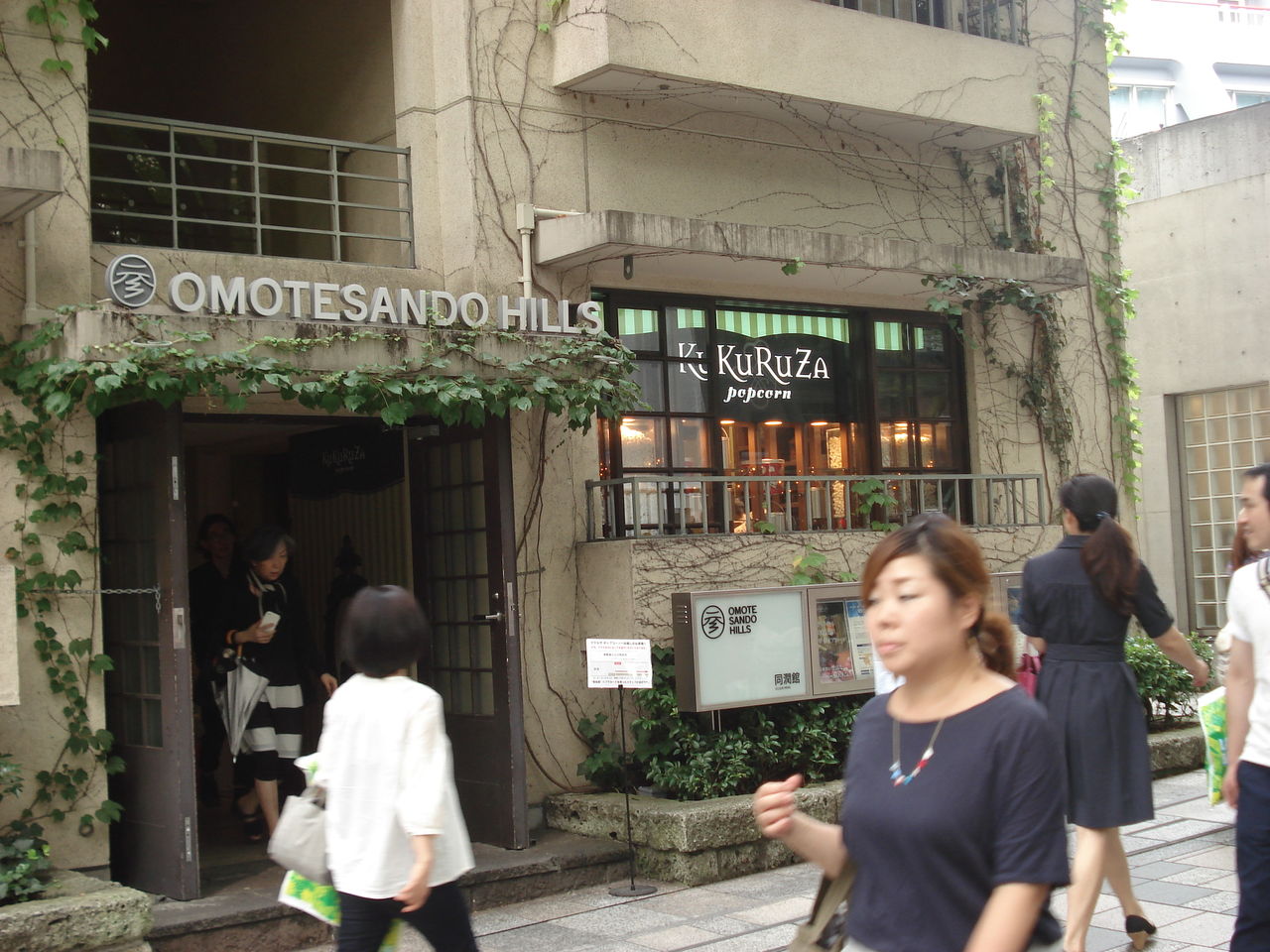
street view 6 popcorn shop 2Nine out of ten, you'll come across a line of young women and men who are waiting for something.

The line starts at a popcorn shop, KuKuRuZa, which originated in Seatle in US and now gets more popular here in Tokyo.
(The board says "the tail of  line.")
 

street view 6 popcorn shop


street view omotesando hills insideHere is Omotesando Hills, a modern building uniquely designed insides, where  corridors are inclined as pallarel to the downhill street outside. About 100 fashionable shops are open.

The 12-storied architecture has six floors on the ground due to the height restriction, which means 6-storied under the ground.

street view 6 Kiddy landOn the opposite side,
KIDDY LAND, a shop of small toys and goods with cute characters such as Sanrio's Kitty and Desney's, stands with bright sign,  swallowing young girls and boys.


street view 6 Oriental landOriental Bazaar, a souvenior shop providing with Kimono, pottery, and Ukiyoe at reasonable prices, shows up in a traditional architecture with red pillars and green roofs.


DSC02467Heiroku Sushi,  an inexpensive sushi bar where plates of sushi rest on a circular conveyer belt, serves a wide variety of sushi including California roll, avocado roll and so on.


street view 8 commercalColorful commerical displays appear when you cross an intersection where the road  changes from downhill to uphill.

The advertisements might overwhelm you in size and height.


 street view 5 HM
H&M, a Swedish apparel company, soars before you, too.


street view 9 ukiyoe musiumOn the right, at the halfway point of the uphill,  you'll find a musium of Ukiyoe, called Ukiyo-e Ota Memorial Museum  of Art, which possesses a large collection of valuable woodblock prints (about 14,000).

Ukiyoe enthusiasts will find numerous masterpieces during the Edo Period (the 17th -19th centuries) .


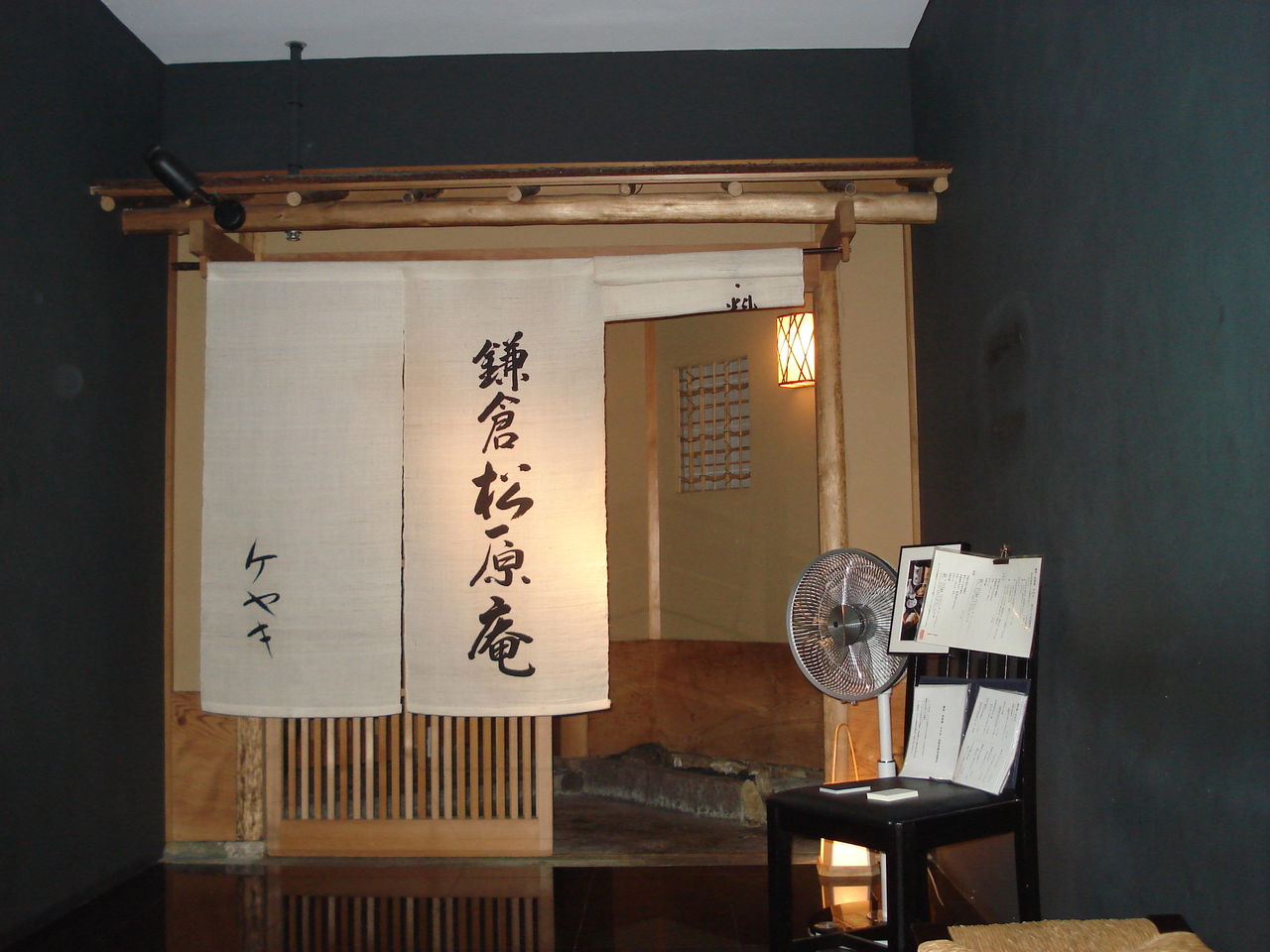
street view 9 Soba restarurantGoing up for a while, if you don't miss a small shop sign, Matsubara-an Keyaki, you'll have a chance to know one of Japan's noodle cultures, Soba noodle.

The buckwheet noodle is commonly  taken for lunch, served with various toppings such as tempura or deep flied dish of fresh vegetables and fish.

The entrance of restaurant is on the 4th floor of a modern building, where you'll see Noren or a traditional short curtain with the shop name on it, hanging from the eaves.
street view 8 entrance of shrine
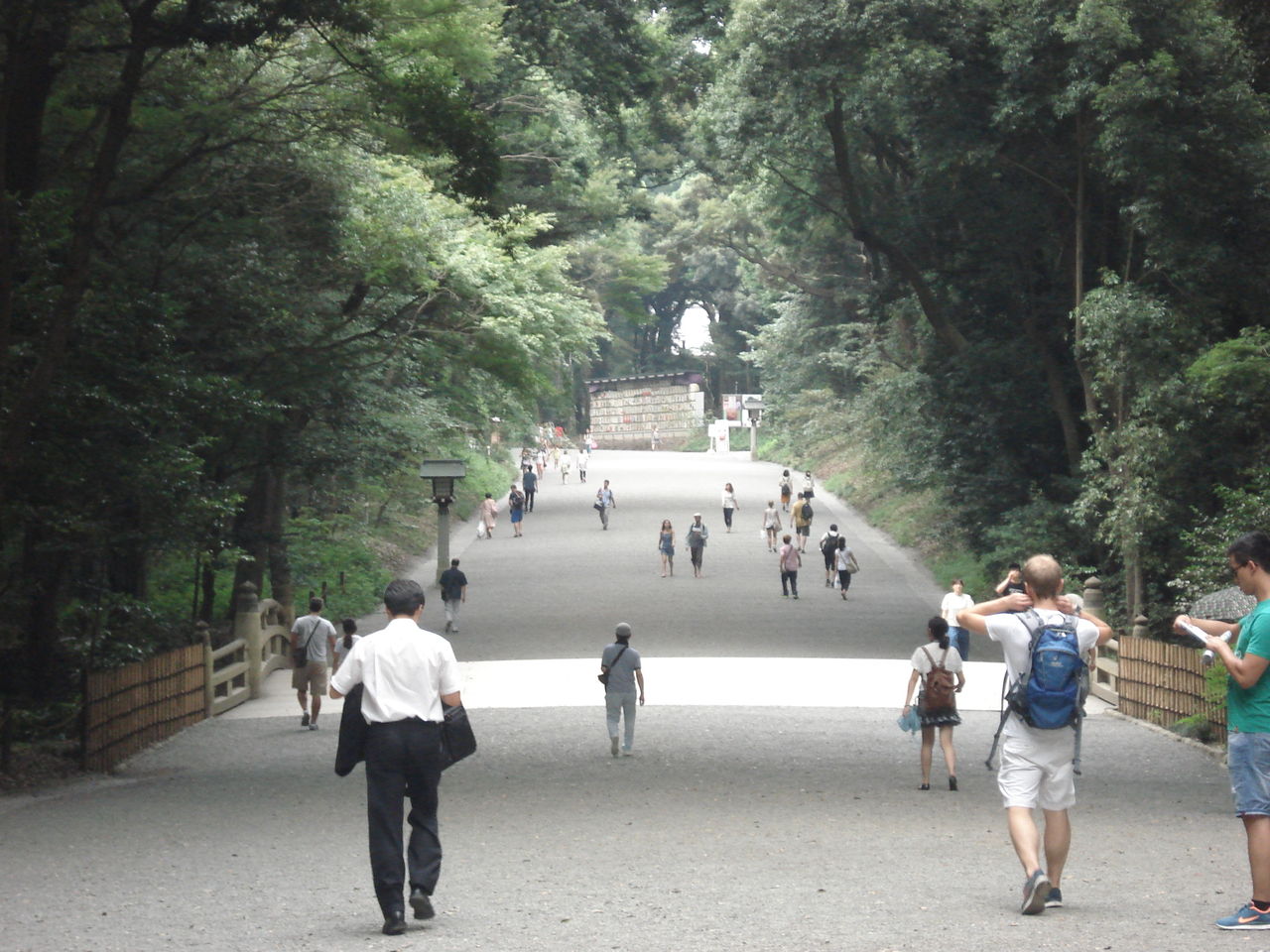
At last, a few minutes walk takes you to the top of Omotesando, where the Zelkova street faces a deep forest.


Crossing the pedestrian walk,
you see a huge Torii gateway on your right.

street view 8 Meiji shrine Torii gate (2)Unlike the triumphal arches in Paris and Verlin, the wooden gateway is simple and natural, harmonized with nature.

It has a role of clearly distinguishing the sacred area of shrine from the worldly area you've come from.


DSC02395Walking on a path paved with gravel,  you are coming closer to Meiji-Jingu Shrine, which enshrines Emperor Meiji and Empress Syoken.

The emperor ruled in 1868 -1912, and achieved Meiji Restoration which drastically modernized the country from its fuedal system. 


Meiji shrine gate DSC02402The Shinto architecture represents what we have kept embrasing for centuries as a token of worship and appreciation to ancestors and nature.


Meiji Jingu shrine 2