Mt. Fuji

Mt. Fuji
Absolutely Fantastic !!! Mt. Fuji, best viewed in winter, stands in blue sky without any clouds

Wednesday, December 31, 2014

Who owns Mt. Fuji?

The picture was taken this March when I visited Mt. Fuji with our associates.
We are very impressed to see its magnificent appearance everytime we visit there. 
While we gazed with rapture, a woman asked "who owns Mt. Fuji?" 
Then we came back to our senses.
①高速道路からの眺め DSC02051
You would answer that it must be a national property.
That's right, but partially right.

You would be surprised to know that the top 20% part of Mt. Fuji belongs to a shrine which is located at the lower hillside, Sengen Shrine.
The area has been used as the precinct of the shrine for a long time.
That was the main reason of  Japan's Supreme Court decision made about 40 years ago.

Wow !  There is a branch shrine at the top of Mt. Fuji !!!
Why don't we go up to the top this summer ? 

Sumo wrestling exhibition at a shrine in Tokyo

Talking about Sumo Wrestling, you might associate bouts on the ring with two naked giants wearing waist belts and head knots. Yes, that's right.
But the Japanese wrestling is not just fights to decide a man of power.

On the 4th of April, people more than 6000 enjoyed a ritual performance of  Sumo at a famous shrine in Tokyo. (addmission free)
Understanding of its ritual backgrounds gives you an approach closer to the Japanese culture. 

The day started with a Shinto style of ceremony on the ring early in the morning(9 am), when bottles of Sake, Japanese rice wine, were offered to the diety, and then some of them was poured on the ring to purify the place where bouts were going to be held.
①土俵祭(1) DSC02086

Young wrestlers gathered at the ring and began their training matches up on the ring one by one in turns.
②力士稽古DSC02091
Then, Senior wrestles, ranked in the official list, showed up all together, greeting to the audience. Some introduced their new born babies. (You see babies held in their arms.)
⑧幕内土俵入りDSC02114
A Grand Champion, wearing a sacred rice straw on the waist, offered the ritual prayer form. All who attended there gazed at him silently.  
⑨白鵬土俵入り(2)DSC02122
Setting the legs opened with the waist lowering, he bowed deeply with the arms stretched widely.
⑨白鵬土俵入り(3)DSC02123
Then Sumo matches started on the ring.
A high-ranking refree wears a traditional style of cloths similar to those of top priests. He is the only person who is entitled to wear Japanese slippers on the sacred ring.(Take a close look at his feet. You'll see white socks, tabi, and slippers, zouri.)
⑮行司 DSC02137
Following is a shot of  the final bout with two grand champions.
⑬横綱取組DSC02152
During intermission,
some wrestlers sang songs which were originated in the 17th  century (at the Edo period). They arranged words of the songs so as to reflect situations in the current society and entertained the audience successfully.  
⑤相撲甚句(2)DSC02103
In addition, they made a drum performance, traditionally used in their society since the Edo period, to let wrestlers know the time for training (maybe around 4 am) .
⑦櫓太鼓DSC02109
It was at around 3 pm that the whole performance and ceremony were finished.
People were leaving the shrine with another kind of drum sound that were seeing them off.

A Japanese garden in Tokyo --- Shogun and his favarite feudal lord enjoyed it in the 18th century.

Just in the center of Tokyo, you'll find a Japanese garden, where you feel more and more calm and relaxed as you walk around.  This garden, called "Rikugien garden", is a good example of a "stroll garden" that Shogun and feudal lords enjoyed the miniature of nature in the 18th century.
Now people also love to visit the garden, looking for the place where they can keep a peaceful mind.  This is located close to Komagome station of Yamanote line of Japan Railway East (JR east).

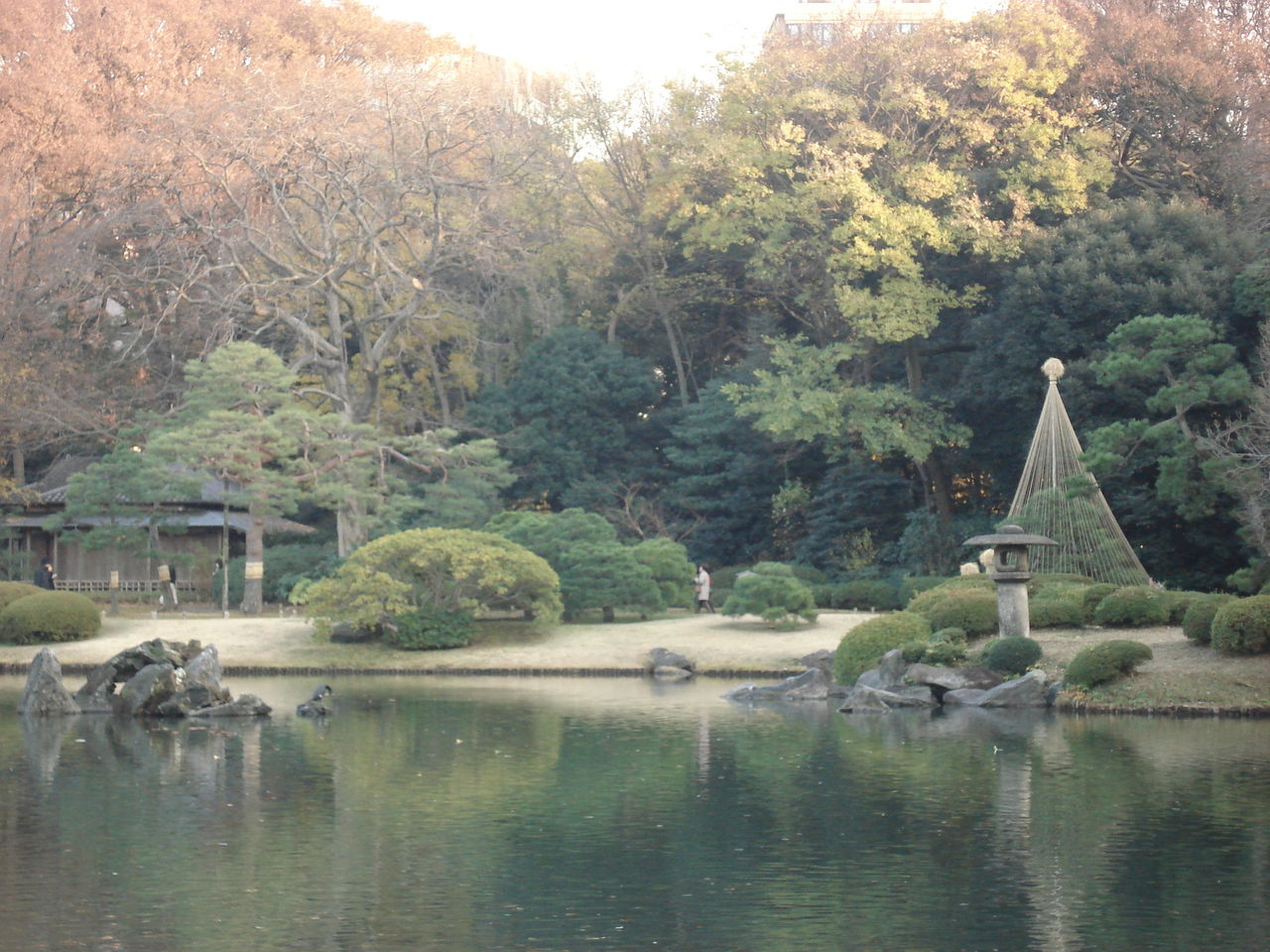
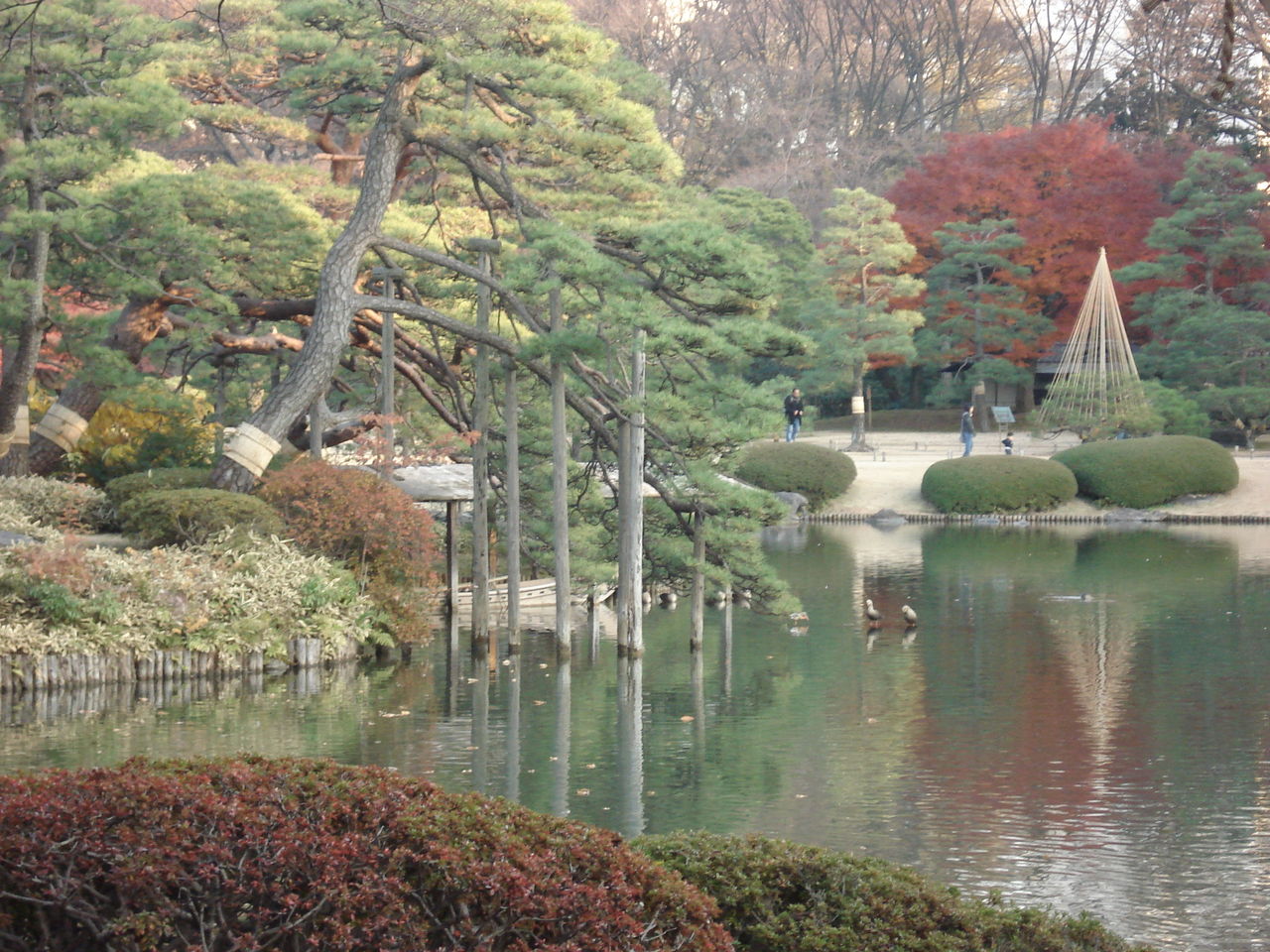
Following pictures are showing its beauty in autumn, but the garden  reveals various seasonal aspects of nature it has enbraced for more than centuries.

<entrance with colored maple leaves>
DSC01043

<main pond, rock island, stone lantern, and shore>
DSC01060

<pine trees leaning over the pond>
DSC01061

<view from the top of garden>
DSC01062

Kiyomizu-dera temple where you can overlook the whole city of Kyoto

The Buddhist temple, founded in the 8th century, is very famous for its structure hanging over a mountain cliff, and is also popular with many shops along the approach which consists of many stone steps and long slopes.

We recommend you to visit there if you are comfortable in walking up on a bit longer uphill.  You would be impressed with a panoramic view of Kyoto as well as old street views of the old capital.

kiyomizu sannneizaka 2Let's get started from the foot of an approach called Sanneizaka. You'll walk on a flat stony path and often go up several series of stone steps. The narrow uphill suggests that  it was made long long ago like roads of old towns in Europe.

You'll see various kinds of shops selling picture cards, souvenior items, or pottery. The area is very famous for its traditional pottery-making.

kiyomizu sanneizaka 7kiyomizu sanneizaka 6


It's a good idea to take a rest at a confectionary restaurant, where you can enjoy a combination of green tea and a piece of Japanese cake, sitting on a bench covered with red cloth.

kiyomizu 2 pagodaComing up through the busy street, you'll be in a open space where a red gate, called Niou-mon, stands before you.

Here starts the area of a Buddhist temple, Kiyomizu-dera, which refers to a pure water temple. Actually even now it has a spring in the back yard,  and people have believed that drinking the water is good for health since the time when it was found.

The Nishi-mon gate and the three-storied pagoda follow on your right. The pagoda is a symbolic component of temple architecture where Buddha's ash is stored and enshrined. That's why it has a high structure with several stories.

kiyomizu stage front viewWalking up several minutes, you'll finally reach the main building, called Hondo, which was re-built about 400 years ago and keeps its original  structure showing a synmetric, elegant appearance.


kiyomizu image of BuddhaThe Buddha image, enshrined in the Hondo, is very unique in having 11 faces and 42 hands. The exaggerated appearance indicates that he has unlimited ability of salvation for all the worldly people.  So, for 1200 years, a numerous number of people, suffered from wars and diseases, have visited here to pray peaceful life and ask for good health.

The temple, however, makes it a rule to show the image to the public every 33 years, and people usually look at a reprica which stands before a screen hiding the real one.  You'll be able to see the genuine idol in 2033.


kiyomizu stage from baseThe floor of Hondo is supported by several wooden pillars and beams that are combined without any nail used.  You may be brave enough to look down from the central stage which is about 12 meters high.
We often use a phrase that  "Jump down from the stage of Kiyomizu temple."  when making a very difficult decision.


kiyomizu panoramic viewTurning back to the city of Kyoto, a panoramic view of the old capital is there.
You may notice that Kyoto is surrounded with mountains in all direction except the south, which means the city used to be a natural fortress.
In addition, streets and avenues there, constructed in the 8th century, are crossed regularily, which shows that people at the time had an excellent city planning.

Kiyomizu-dera temple has been looking over the old capital for 1200 years. 

Fish Markets at Tsukiji in Tokyo --- Q & A

★Where is it?Tsukiji Honganji  
Coming up stairways of a subway station, Tsukiji, you will find yourselves standing in front of a Buddhist temple called Tsukiji Honganji, where you see a stone-made and Indian style of building. That's completely different from traditional Japanese wooden temples usually based on Chinese architecture.  It is  modernly fashioned because it was re-built after the great  earthquake hitting Tokyo area in 1923. The fish markets were also moved here after the earthquake in 1935.  

Crossing an intersection, a few minutes’ walkTsukiji outer market
leads to a town like a bazaar where many stalls gathering closely side by side sell fresh fish and grocery or serve sea food to eat. This is the retail area of the Markets.


Walking further for a while,Tsukiji front gate
you come to the front gate of the wholesale area of Tsukiji Market, where many vehicles such as trucks and carts are frequently running with a pile of white boxes made of foam polystrene.  


★When does the wholesale area open?
    It opens at 3:30 am, when people related to the market, such as wholesalers, jobbers, and retailers, come to join auctions or make a deal with each other.  Then retailers  carry things they got to their trucks, while jobbers start cleaning up their stalls. It's around 8:30 am that they finish most of their jobs. The whole market is closed by noon.
    You are generally allowed to enter the area after 9 am as long as you do not disturb their activity, walking on the sides of roads or crossing paths after letting small carriers pass first. 
   Being deep into the area,
Tsukiji inner market arc
you see a big arc-shaped building.
That is the heart of the area, the wholesale market of sea foods.


★Why is it arc-shaped?     The market used to have a railway to transport sea foods by train, and there were many platforms that were made along curved rails. That’s the reason.

The railway transportation had continued for 40 years, but trucks took place of the old system 30 years ago. Seventy years has passed since its establishment, and now modern buildings that replace the old market are under construction in a seaside area. They will complete in 2016.  So I’m sure that you fortunately come and see how the wholesale has been operated in a traditional way, which disappears in two years.


★What is the inside like?Tsukiji inner market 2
   Aisles and alleys are arranged regularly like arcs and radii in geometry, with address displays hanging from the ceiling.  


   Along these small paths, numerous stalls stand side by side with their names on top. Each stall is about 5 to 10 meters wide, which means that no more than 800 wholesalers are in the arc. The number might be surprising and amazing, but is natural because they Tsukiji inner market address displaysupply sea foods for 13 million people in Tokyo.


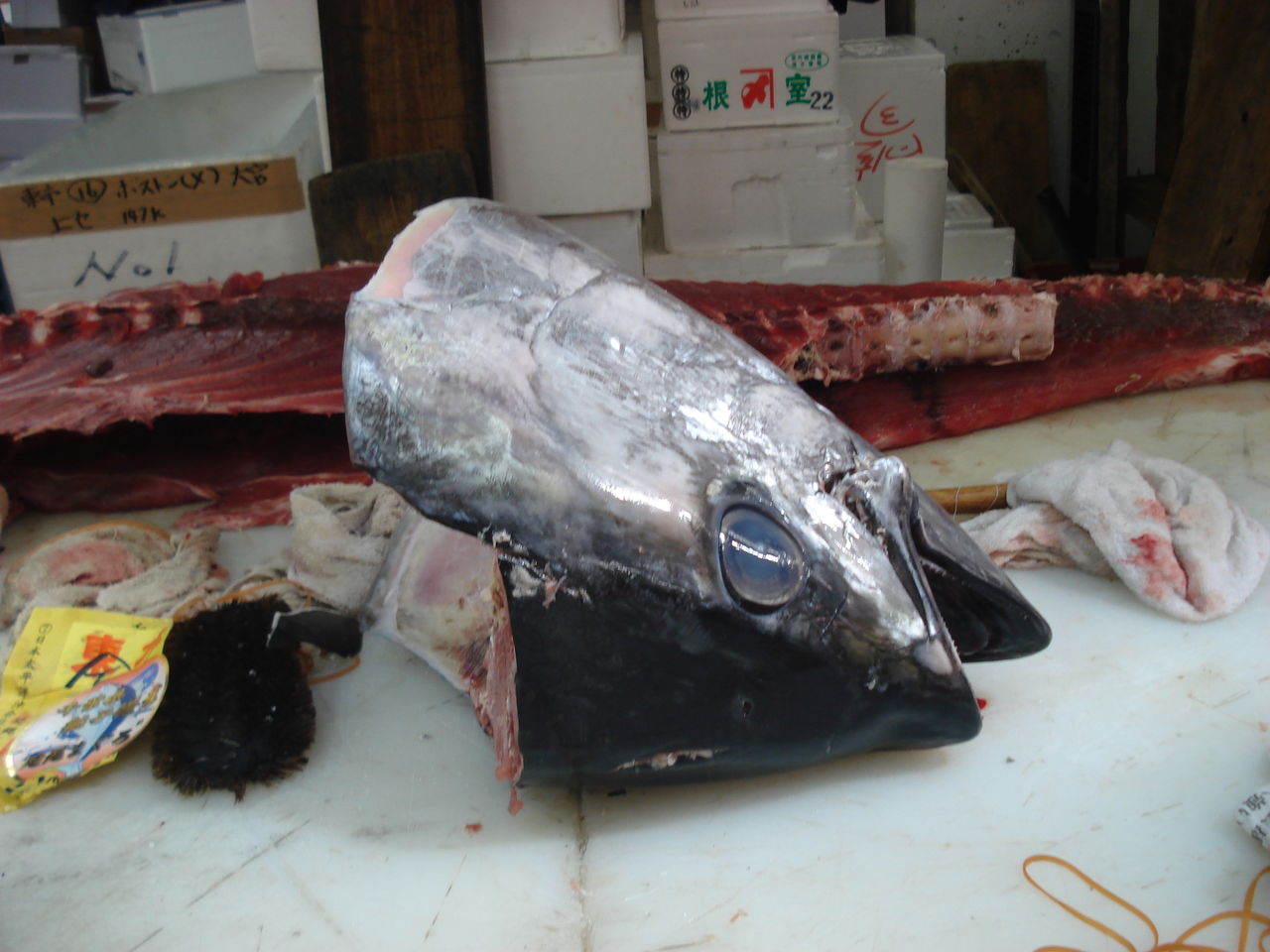
   They have a wide variety of sea foods such as fish, shellfish, crabs, lobsters, octopuses, roe, and sea vegetables.  What is the most special among them is the head of tuna, which is called Kabuto, or Armor helmet, from its shape.  The broiled head of tuna, called Kabuto Broiled, is well-knwon as a valuable, delicious and nutritious dish in Japan.  Here would be the only place in the metropolis where you can take a close look at Kabuto  here and there.Tsukiji Kabuto

★How is the smell of fish?
   You would be anxious about fries and unpleasant smell of fish, but you don't have to worry about them because the whole site is kept in perfectly sanitary condition.  I' ve never felt unpleasant there.  Please note that tourists are also required to keep hygienic rules such as no drinking, no eating and no smoking in the wholesale area.  

   Japan is surrounded with waters and has long history of fishery.  So I’d say that Tokyo has the world’s largest  variety of sea foods.

   You’ll have a good experience that you cannot have in the other countries.


Sunday, August 24, 2014

My Services

(1) Number of clients
I am engaged in personal tours where the number of clients is less than six.

(2) Area
The area I cover is Tokyo and its vicinity within around 100 kilometers.
For example, cities included in the area are Narita in the east, Nikko in the north, Hakone in the west, and Kamakura in the south.

I could be your guide in Kyoto and Hiroshima if you request. Hiroshima is my hometown and I spent several years in my youth in Kyoto. That is why I am familiar with both cities.  But please note that trasportation fee from Tokyo is to be added while accomodations for me is not necessary.

(3) Transportation
I mainly take public trasportation such as railways and subways, which is convenient and cost-saving in Tokyo.  But It's OK to take a taxi or a hired car at remote areas with some reasons such as health conditions, bad weather, and so on.

(4) Time
I basically prepare three options:
  - half day tour ( 4 hours for each term)
  - full day tour  ( 8  hours including lunch)
  - evening tour  ( 4 hours including dinner)
But I am flexible in scheduling your tour in the range from two hours through twelve hours, depending on your convenience.

(5) Foods
Please let me know your preferences or restricted food in advance.

(6) Prices
 $25/hour  for up to two persons in a group
 $30/hour  for three through five persons in a group

About Me

(1) Three Cs : Courteous, Curious, and Comfortable

Every communication starts with courtesy, and I keep having a sense of host in this country. I suppose that what brings you to our country would be curioisity in mind, and I will make it more and more  stronger by introducing something new to you even if you are repeaters. Lastly I would like you to feel comfortable and relaxed during your stay, which would be essential for tour guides. I will provide comfortable walking, talking, eating, and watching, depending on your preference.

(2) Experiences of teating business customers

I retired from business last year, and now live in Tokyo to enjoy my own life. I was brought up in Hiroshima, spent several years in my youth in Kyoto, and worked mainly in Tokyo. During those days,  I had a number of chances to introduce our customers cultural and/or historical spots on weekends or after finishing meetings, which led me to a new job, a tour guide. In addition, I've visited more than twenty cities and areas overseas on business or privately so far. That helps me understand our country in various points of view.

One example is a riddle:  "Which stood earlier, The great statue of Buddha in Nara or that in Kamakura?" 
I wonder that's make sense for you.

(3) Area where I work
I mainly cover Tokyo area, and I'd say that the current capital has things more interesting and exciting to see and experience  than the old ones, Kyoto and Nara.